
Picture this: it’s a sold-out Saturday night at your property. A guest in Room 412 has ordered room service, dimmed the lights, and settled in to watch the big game. Twenty seconds in — pixelation. Then buffering. Then a dead screen. They call the front desk, fuming. Sound familiar? That single moment of streaming failure costs you not just a complaint, but a negative TripAdvisor review that lingers for years.

The culprit, more often than not, isn’t your TV or your internet connection — it’s a cheap, under-specced HDMI encoder that simply can’t handle the job. That’s exactly why understanding the HDMI encoder for hotel IPTV system multi rate setup is no longer a nice-to-have for hospitality operators — it’s mission-critical.
Wanna try out our IPTV service ? Click HERE & get an IPTV FREE Trial Account NOW !
What Exactly Is an HDMI Encoder for Hotel IPTV — and Why Does Multi Rate Matter?
Let’s strip away the jargon for a second. An HDMI encoder is a device (hardware or software) that takes a raw video signal — say, from a satellite receiver, a live camera feed, or a Blu-ray player — and converts it into a compressed digital stream that can travel over your hotel’s IP network to every TV on the property. Simple enough, right? Here’s where it gets interesting.
Multi rate encoding — sometimes called adaptive bitrate or ABR encoding — means your HDMI encoder for hotel IPTV system multi rate simultaneously outputs the same content at multiple quality levels and bitrates. Think of it like a water tap that automatically adjusts its flow depending on the size of the pipe it’s feeding. A room with a brand-new 4K smart TV on a wired connection gets the high-bitrate, ultra-crisp stream. A device on a weaker Wi-Fi signal gets a lighter stream — still watchable, still smooth. No buffering. No complaints. Everyone’s happy.
Without multi rate support, your encoder broadcasts at one fixed quality. That might work perfectly for some rooms and catastrophically for others. In a hotel environment with dozens — or hundreds — of simultaneous viewers, that’s a recipe for disaster.
How Does Multi Rate HDMI Encoding Actually Work?
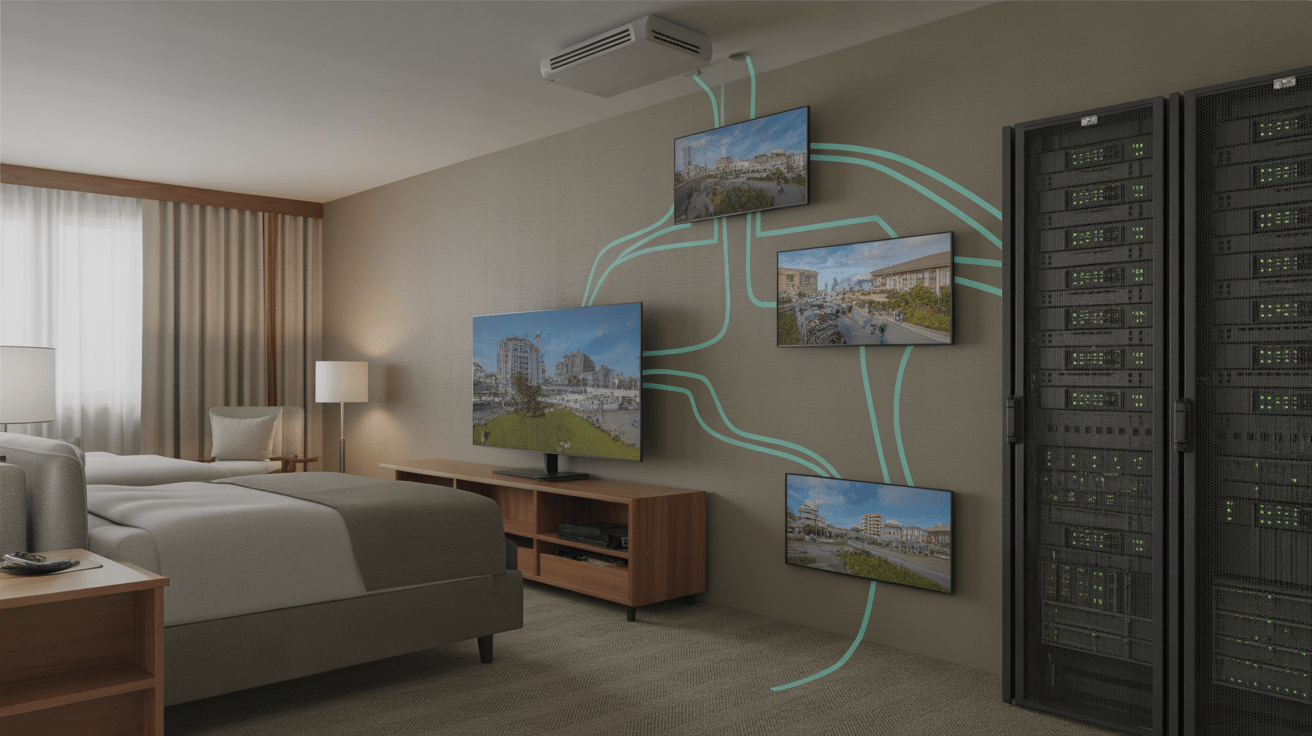
Here’s the rub: multi rate encoding isn’t magic, it’s math — very clever math. Your HDMI encoder for hotel IPTV system multi rate accepts the incoming HDMI signal and encodes it using codecs like H.264 (AVC) or the more efficient H.265 (HEVC). It then simultaneously produces multiple output streams at different resolutions and bitrates — for example:
- 4K / 2160p at 15–25 Mbps for premium rooms with 4K TVs
- 1080p Full HD at 4–8 Mbps for standard rooms
- 720p HD at 1.5–3 Mbps for older or smaller screens
- 480p SD at under 1 Mbps as a fallback tier
The IPTV middleware or your head-end system then serves the right tier to each device automatically. That’s the ABR magic at work. Your guests never see the mechanics — they just see a flawless picture.
Wanna try out our IPTV service ? Click HERE & get an IPTV FREE Trial Account NOW !
Key Features to Look for in an HDMI Encoder for Hotel IPTV System Multi Rate
Not all HDMI encoders are created equal. Buying the wrong one is like hiring a chef who can only cook one dish — fine until someone orders something different. Here’s what you genuinely need to look for:
1. Codec Support: H.264 vs H.265
H.265 (HEVC) delivers roughly the same quality as H.264 at half the bitrate. For a hotel with bandwidth constraints, that’s enormous. However, H.265 encoding is computationally heavier, which means your hardware needs to be beefy enough to handle it without dropping frames. A good HDMI encoder for hotel IPTV system multi rate should support both, giving you flexibility as your infrastructure evolves.
2. Number of HDMI Input Channels
A boutique hotel might get away with 4 or 8 HDMI inputs. A resort with live event feeds, multiple satellite receivers, and local camera feeds could need 16, 32, or more. Match your encoder’s input count to your actual channel lineup — and then add 20% for future growth. Trust me on that one.
3. Output Protocols: HLS, RTSP, RTMP, UDP
Your IPTV middleware needs to receive the stream in a format it understands. Most professional hotel IPTV systems work with HLS (HTTP Live Streaming) for ABR delivery, while RTSP and UDP are common for legacy setups. Make sure your encoder speaks the right language before you sign any purchase orders.
4. Built-in EPG Support
Guests want to know what’s on, not just what’s playing right now. An encoder that integrates cleanly with an Electronic Program Guide (EPG) system turns your hotel TV into something that feels like a premium cable package rather than a static feed.
5. Redundancy and Failover
For a property that can’t afford downtime — which is every property — look for encoders with dual power supplies, automatic failover, and remote monitoring. If one channel drops, the system should self-heal without anyone having to climb into a server rack at 2 AM.
Comparing Popular HDMI Encoder Types for Hotel IPTV
| Encoder Type | Best For | Multi Rate Support | Typical Cost Range | Scalability |
|---|---|---|---|---|
| Hardware Rack Unit (e.g., Haivision, Matrox) | Large hotels, resorts, casinos | ✅ Yes (ABR native) | $2,500–$15,000+ | High |
| Mid-Range Hardware Encoder (e.g., Kiloview, Teradek) | Mid-size properties (50–200 rooms) | ✅ Yes | $800–$2,500 | Medium |
| Software Encoder (e.g., FFmpeg-based appliance) | Budget properties, tech-savvy operators | ⚠️ Varies by config | $200–$800 | Low–Medium |
| Cloud Encoder (SaaS-based) | Properties with strong internet uplinks | ✅ Yes | Monthly subscription | Very High |
Multi Rate vs Single Rate: A Real-World Hotel Scenario
Let’s be honest about what happens when you choose wrong. A 150-room hotel in a coastal resort town deployed a single-rate encoder pushing everything at 1080p/6 Mbps. Great choice — for the rooms on the wired network. But 40% of the property relied on Wi-Fi distribution. During peak occupancy? Buffering on nearly every wireless device. Guests were livid. The operator scrambled to upgrade — a costly, disruptive mess that could’ve been avoided from day one with an HDMI encoder for hotel IPTV system multi rate setup.
Contrast that with a comparable property that invested in ABR encoding upfront. Multi rate streams meant every device — wired or wireless, old or new — received a signal optimized for its connection. Guest satisfaction scores for in-room entertainment jumped 22% within the first quarter. That’s not a coincidence. That’s good engineering paying dividends.
Wanna try out our IPTV service ? Click HERE & get an IPTV FREE Trial Account NOW !
Bandwidth Planning: How Multi Rate Encoding Saves Your Network
Here’s a number that should make any IT manager sit up straight: a single 1080p stream at 8 Mbps, multiplied across 200 simultaneous viewers, is 1.6 Gbps of sustained bandwidth. That’s before you factor in guest Wi-Fi, PMS traffic, and back-office systems. Multi rate encoding doesn’t just improve quality — it actually reduces average bandwidth consumption because lower-tier devices aren’t pulling more data than they can use. Smarter delivery, leaner network load, happier guests.
For deeper context on how IPTV technology is evolving to handle exactly these demands, our piece on IPTV Technology Innovations 2026 is worth a read — it puts the engineering advances into plain English.
Installation Tips: Getting Your HDMI Encoder Setup Right the First Time

Step 1: Audit Your Signal Sources
List every HDMI source you need to encode — satellite tuners, local broadcast antennas, cable boxes, in-house channel cameras. This determines how many encoder channels you need and what input formats (HDMI, SDI, composite) your encoder must support.
Step 2: Map Your Network Infrastructure
A multi rate HDMI encoder for hotel IPTV system multi rate delivery is only as good as the network beneath it. Assess your core switches, access layer, and whether you’re running a dedicated IPTV VLAN (you should be). Document latency, available bandwidth, and any bottlenecks before a single encoder is racked.
Step 3: Choose Your Middleware
Your encoder and your middleware need to be friends. Popular hotel IPTV middleware platforms handle channel lineup management, VOD, guest billing integration, and EPG. Confirm that your chosen HDMI encoder speaks the same protocol language as your middleware before purchase — this is the compatibility step most operators skip and later regret.
Step 4: Configure Multi Rate Profiles
Once installed, configure your encoding profiles: resolutions, bitrates, and keyframe intervals for each tier. A good rule of thumb is to start with three tiers (720p, 1080p, and optionally 4K) and test on a subset of rooms before rolling out property-wide.
Wanna try out our IPTV service ? Click HERE & get an IPTV FREE Trial Account NOW !
Common Mistakes Hotels Make With HDMI Encoders
- Under-provisioning channels: Buying a 4-channel encoder for an 80-channel lineup. Do the math before you buy.
- Ignoring heat management: Encoders generate significant heat. Poor rack ventilation = hardware failures at the worst possible time.
- Skipping firmware updates: Manufacturers regularly release updates that fix encoding bugs and improve stability. Set a quarterly review.
- No monitoring dashboard: If you don’t have real-time visibility into each channel’s health, you’re flying blind.
- Choosing single-rate to save money: As we’ve seen, the short-term saving becomes a long-term headache.
If you’re building out a full hotel IPTV system from scratch, our comprehensive guide on How to Choose an IPTV Encoder for Large Hotel walks through the full decision matrix in detail. And if you’re wondering whether a premium encoder investment truly pays off, Why Investing in an IPTV Encoder Over $2500 Is Worth It makes a compelling financial case.
Why the Right HDMI Encoder Is a Revenue Decision, Not Just a Tech Decision
Spoiler: guests don’t remember the hotel that had the fastest check-in. They remember the one where the TV worked perfectly, where they found their favorite channel instantly, where everything just felt premium. That’s what a properly deployed HDMI encoder for hotel IPTV system multi rate setup delivers — not just good tech, but good business.
According to Hospitality Net, in-room entertainment consistently ranks among the top five factors influencing guest satisfaction scores in full-service hotels. That’s not a small detail. That’s a competitive differentiator. And it starts with getting your encoding layer right.
Ready to Upgrade Your Hotel IPTV Streaming Experience?
Whether you’re starting from scratch or replacing an aging single-rate system, the path forward is clear: invest in a quality HDMI encoder for hotel IPTV system multi rate delivery, plan your network properly, and choose middleware that works seamlessly with your hardware. Your guests will notice — even if they never know why.
Wanna try out our IPTV service? At IPTV Trends, we understand the demands of professional streaming environments inside and out. Explore our best IPTV provider recommendations for 2026 and discover how we help operators — from boutique properties to massive resorts — deliver flawless, buffer-free entertainment to every screen on the property. Don’t let a bad encoder be the reason your guests leave a one-star review. Let’s fix that together.
Wanna try out our IPTV service ? Click HERE & get an IPTV FREE Trial Account NOW !
Conclusion
The HDMI encoder sitting in your server rack is doing a job most guests will never appreciate — until it fails. Multi rate encoding transforms your hotel IPTV system from a potential liability into a genuine guest experience asset. It protects your network, scales with your property, and ensures that whether a guest is in the penthouse or a standard double, they get a stream that feels premium. Choose wisely, configure thoughtfully, and monitor continuously. That’s the formula for hotel IPTV excellence in 2026 and beyond.
FAQ: HDMI Encoder for Hotel IPTV System Multi Rate
1. What is a multi rate HDMI encoder and why do hotels need it?
A multi rate HDMI encoder simultaneously outputs video at multiple resolutions and bitrates, allowing each guest device to receive the stream quality best suited to its connection speed. Hotels need this because room types, network infrastructure, and device capabilities vary widely across a property, and a one-size-fits-all single-rate stream inevitably fails some guests.
2. What codec should I choose for my hotel IPTV HDMI encoder — H.264 or H.265?
H.265 (HEVC) is more efficient, delivering the same visual quality at roughly half the bitrate of H.264. This is ideal for bandwidth-constrained hotel networks. However, H.265 requires more processing power. Ideally, choose an HDMI encoder for hotel IPTV system multi rate that supports both, giving you the flexibility to switch as your infrastructure matures.
3. How many HDMI encoder channels does a typical hotel need?
It depends entirely on your channel lineup. A small boutique property with 20 live channels needs at minimum a 20-channel encoder (or multiple smaller units). Larger resorts with 80–150 channels, plus local feeds and VOD injection points, will need enterprise-grade multi-channel hardware or a scalable software/cloud encoding solution.
4. Can I use a software-based HDMI encoder for my hotel IPTV system?
Yes, but with caveats. Software encoders running on server hardware can handle multi rate encoding well if the underlying CPU/GPU is powerful enough. They’re cost-effective for smaller properties but may lack the reliability features (redundant power, hardware failover) that dedicated rack-mount encoders offer. For mission-critical hotel deployments, hardware encoders generally provide better uptime guarantees.
5. What protocols should my HDMI encoder support for hotel IPTV delivery?
The most common protocols in hotel IPTV environments are HLS (HTTP Live Streaming) for ABR multi rate delivery, UDP multicast for IPTV head-end distribution, RTSP for legacy middleware compatibility, and RTMP for cloud-based streaming integrations. Your encoder should support at least HLS and UDP to cover the majority of hotel IPTV middleware platforms.
6. How does multi rate encoding reduce bandwidth usage on hotel networks?
Instead of every device pulling the maximum bitrate stream regardless of its actual need, multi rate encoding (ABR) allows devices with weaker connections to pull a lower-bitrate stream. This reduces average network load significantly — sometimes by 30–50% across a mixed-device environment — freeing up bandwidth for guest Wi-Fi and other hotel systems.
7. Does my HDMI encoder need to integrate with hotel middleware?
Absolutely. Your HDMI encoder for hotel IPTV system multi rate feeds streams into your IPTV middleware, which handles channel management, EPG, VOD, and guest-facing interfaces. Incompatible protocols between encoder and middleware are a common — and expensive — installation mistake. Always verify protocol compatibility (HLS, RTSP, UDP) before purchasing either component.
8. What is the average cost of a professional HDMI encoder for a hotel IPTV system?
Costs vary dramatically by scale and capability. Entry-level 4-channel hardware encoders with basic multi rate support start around $800–$1,200. Mid-range 8–16 channel units with full ABR, redundancy, and EPG support range from $2,500–$6,000. Enterprise-grade rack units from brands like Haivision or Harmonic can exceed $15,000 for large-scale deployments. Factor in long-term ROI through guest satisfaction, not just upfront price.
9. How do I monitor my HDMI encoder’s performance in real time?
Most professional hotel-grade HDMI encoders include a web-based management interface or SNMP support for integration with network monitoring platforms. Look for encoders that offer per-channel health dashboards, bitrate monitoring, error logging, and email/SMS alerting for failures. Real-time visibility is non-negotiable for a 24/7 hospitality operation.
10. Can I retrofit a multi rate HDMI encoder into an existing hotel IPTV system?
In most cases, yes — but it requires a compatibility audit first. Your existing middleware must support ABR/HLS streams, your network must have sufficient bandwidth capacity, and your VLAN configuration must be updated to handle multiple stream tiers. A phased rollout — starting with a section of rooms — is the safest approach to retrofitting an HDMI encoder for hotel IPTV system multi rate delivery into a live property.
Wanna try out our IPTV service ? Click HERE & get an IPTV FREE Trial Account NOW !