
Picture this: it’s Saturday night, every one of your 400 hotel rooms is occupied, the big football match is about to kick off, and your in-room TV system decides to throw a tantrum. Channels freeze. Half the rooms get a black screen. The front desk phone won’t stop ringing. Sound familiar? Here’s the thing — that nightmare almost always traces back to one weak link: a poorly planned multi-channel HDMI encoder hotel IPTV network. Get that part right, and you get glowing reviews. Get it wrong, and you get… well, Friday-night chaos.

In this guide, we’re going to break down exactly how a multi-channel HDMI encoder hotel IPTV network is built, what specs actually matter, what mistakes most hoteliers make, and how to future-proof your investment. No fluff, no jargon avalanche — just the real stuff you need to know before spending a single dollar.
Wanna try out our IPTV service ? Click HERE & get an IPTV FREE Trial Account NOW !
What Is a Multi-Channel HDMI Encoder for a Hotel IPTV Network?
Let’s start simple. An HDMI encoder takes a live video source — think satellite receivers, cable boxes, security cameras, or even a live sports feed — and converts it into a digital stream that can travel over an IP network. A multi-channel encoder does this for several sources simultaneously, often 4, 8, 16, or even 32 channels in a single rack unit.
In a hotel context, those channels feed into a central IPTV headend, which then distributes content to every guest room over the property’s LAN or Wi-Fi infrastructure. The result? Every TV in every room gets a clean, lag-free picture — as long as your encoder is up to the job.
Think of the encoder as the kitchen in a restaurant. Guests only see the beautifully plated dish (the TV picture), but if the kitchen is overwhelmed or poorly equipped, the whole experience collapses. A robust multi-channel HDMI encoder hotel IPTV network is your industrial kitchen — capable of serving hundreds simultaneously without breaking a sweat.
Why Multi-Channel Encoding Is Non-Negotiable for Hotels
Single-channel encoders are fine for a home setup or a tiny B&B. But a mid-to-large hotel? You need something far more muscular. Here’s why multi-channel encoding is the only sensible route:
- Scalability: A 300-room hotel typically needs 20–50 channels to satisfy diverse guest preferences — sports, news, local TV, international feeds, hotel info channels. One encoder with 4 channels won’t cut it.
- Centralized management: Multi-channel encoders let your AV team manage every feed from a single web interface, rather than juggling a dozen separate boxes.
- Cost efficiency: Rack-mounted multi-channel units cost significantly less per channel than buying individual encoders.
- Redundancy: Many enterprise-grade units offer failover features so a single hardware fault doesn’t kill every channel at once.
If you want a deeper look at sizing this for your specific property, the Ultimate Buyer’s Guide for choosing an IPTV encoder for a large hotel is genuinely worth bookmarking.
Key Specs to Look For in a Multi-Channel HDMI Encoder
Not all encoders are created equal. Buying the wrong one is like fitting a garden hose to a fire hydrant — pressure problems, guaranteed. Here’s what to scrutinize:
Wanna try out our IPTV service ? Click HERE & get an IPTV FREE Trial Account NOW !
1. Number of Channels
Count your sources first. Satellite receivers, cable boxes, CCTV cameras, local broadcast antennas — list them all. Then add 20% for future expansion. A 16-channel encoder today that leaves you eight spare ports is a far smarter buy than an 8-channel unit you’ll outgrow next season.
2. Output Format: H.264 vs. H.265/HEVC
H.264 is the workhorse — universally compatible with virtually every IPTV middleware and set-top box on the market. H.265 (HEVC) is the next-gen codec that delivers the same quality at roughly half the bitrate. For a hotel, lower bitrate means less load on your network switch fabric — a genuine operational win. If your STBs and middleware support HEVC, prioritise it. Our deep dive on the Vecaster-4K HEVC HDMI IPTV Encoder is a great reference point for what top-tier HEVC encoding looks like in practice.
3. Multi-Rate / Adaptive Bitrate Output
This is the big one. A multi-rate encoder outputs each channel at several bitrates simultaneously — say, 2 Mbps for standard rooms, 6 Mbps for suites with 4K TVs, and a low-bitrate stream for the hotel’s mobile app. That’s what the pillar topic of HDMI encoder for hotel IPTV system multi rate is all about, and it’s a feature you absolutely cannot skip if you’re running a mixed-device property.
4. Streaming Protocols
Your encoder should support at minimum: RTSP, UDP/RTP multicast, HLS, and ideally RTMP. Multicast is your best friend in large hotel deployments because it sends one stream to the network, and any number of devices can tune in without multiplying bandwidth.
5. Management Interface
A clean, browser-based GUI beats a clunky legacy interface every single time. You want your AV engineer to reconfigure a channel at 2 AM without needing a PhD in networking.
Comparing Popular Multi-Channel HDMI Encoder Options
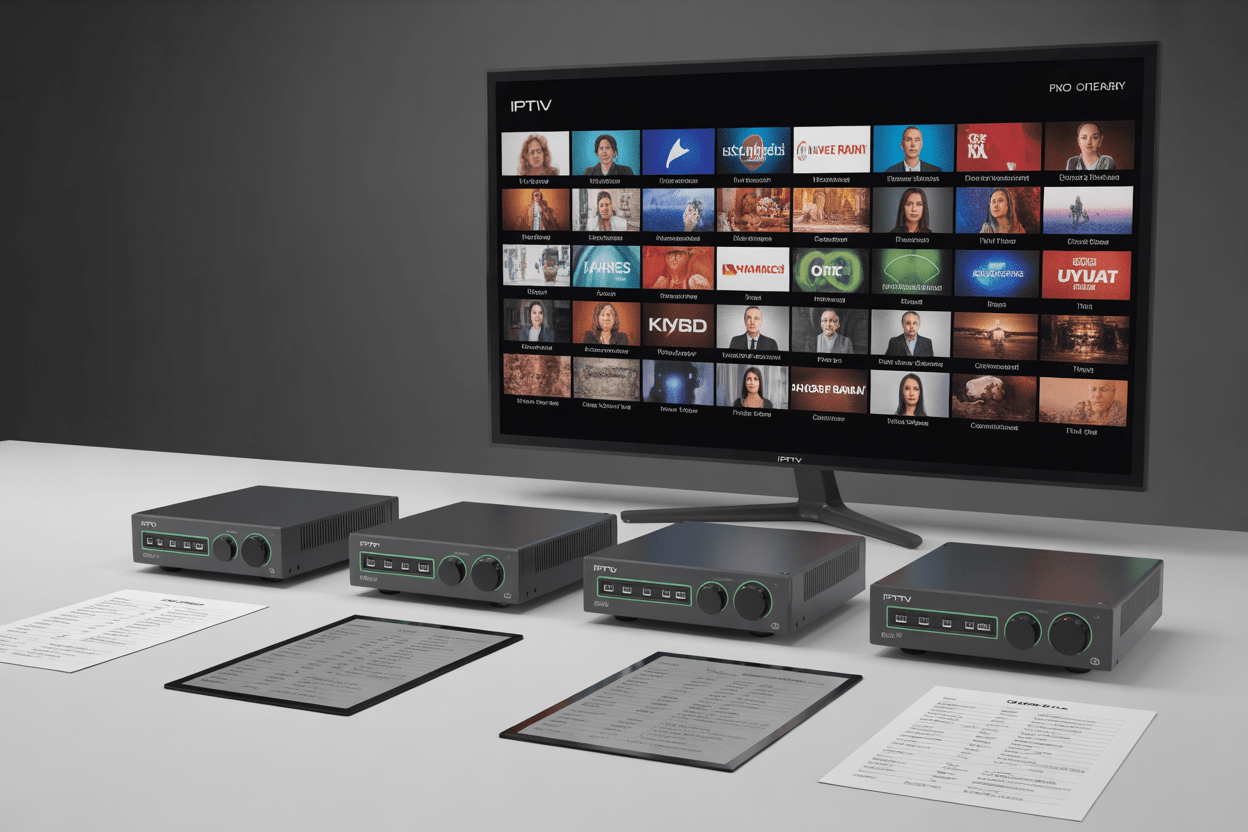
| Encoder | Channels | Max Resolution | Codec | Multicast | Best For |
|---|---|---|---|---|---|
| Makito X4 | 4 | 4K UHD | H.265/H.264 | Yes | Broadcast-grade quality |
| Haivision Makito X | 2–4 | 1080p60 | H.264 | Yes | Mid-size properties |
| Exterity AvediaStream | 4–16 | 1080p | H.264 | Yes | Hospitality IPTV headends |
| Amino AminoHub | Up to 32 | 1080p | H.264/H.265 | Yes | Large hotel chains |
| Vecaster-4K Pro | 1–4 | 4K HEVC | H.265 | Yes | Premium suite deployments |
How to Design a Multi-Channel HDMI Encoder Hotel IPTV Network From Scratch
Designing a multi-channel HDMI encoder hotel IPTV network isn’t just about buying the right box. It’s a system — and every component needs to speak the same language. Here’s a simple architectural roadmap:
Wanna try out our IPTV service ? Click HERE & get an IPTV FREE Trial Account NOW !
Step 1: Audit Your Signal Sources
Walk the headend room. List every satellite receiver, cable tuner, DVD player, and broadcast antenna. Each one needs an HDMI output going into the encoder. If some sources are older with only composite or component outputs, you’ll need converters — budget for those too.
Step 2: Choose Your Encoder Capacity
Match channels to sources, add headroom, and verify the encoder can push multicast streams to your network switch. Cross-check with IPTV encoder pricing research — our IPTV encoder price breakdown is a real eye-opener for budget planning.
Step 3: Configure Your Network for Multicast
This is where many hotel IT teams stumble. Multicast requires IGMP snooping enabled on your managed switches, proper VLAN segmentation to isolate IPTV traffic from guest Wi-Fi, and sufficient uplink bandwidth. A 16-channel HD system at 4 Mbps per channel needs 64 Mbps of reserved bandwidth minimum. Plan accordingly.
Step 4: Integrate With Your IPTV Middleware
The encoder feeds the headend. The headend feeds the middleware (think Ministra, Stalker, or a proprietary hotel solution). The middleware serves the EPG, VOD catalogue, and channel list to the guest room STBs. Every link in this chain needs to be tested before a single guest checks in.
Step 5: Test, Monitor, and Maintain
Set up monitoring alerts so your team knows the moment an encoder channel drops. Firmware updates, bandwidth logs, and periodic stress tests are the maintenance rhythm that keeps the system humming for years.
Common Mistakes That Kill Hotel IPTV Systems

Let’s be honest — most hotel IPTV failures aren’t caused by bad equipment. They’re caused by bad planning. Watch out for these:
- Undersized network switches: Consumer-grade switches can’t handle multicast traffic at scale. Go managed, gigabit, layer-2 minimum.
- Ignoring IGMP snooping: Without it, multicast floods every port on your switch. Instant bandwidth meltdown during peak hours.
- Buying single-rate encoders for multi-device properties: Suites with 65″ 4K TVs and standard rooms with 32″ 1080p sets need different bitrates. Multi-rate encoding isn’t optional.
- No redundancy plan: What happens when the encoder reboots mid-match? Have a failover strategy ready.
- Skimping on cable quality: HDMI cables degrade over distance. For runs over 10 metres, use active HDMI cables or fibre HDMI extenders.
Wanna try out our IPTV service ? Click HERE & get an IPTV FREE Trial Account NOW !
Multi-Rate Encoding: Why It Changes Everything for Guest Experience
Here’s the rub — a hotel isn’t a homogeneous device environment. You’ve got 4K OLED TVs in your penthouse suites, 1080p screens in standard doubles, and guests browsing the hotel app on their phones over Wi-Fi. A single fixed-bitrate stream serves none of these devices optimally.
Multi-rate encoding means your encoder generates two or three bitrate variants of each channel simultaneously. Your middleware or CDN then delivers the right version to each device automatically. The result? Crisp 4K in the suite, smooth HD in the standard room, and buffer-free mobile streaming in the lounge. That’s the magic of a properly tuned multi-channel HDMI encoder hotel IPTV network, and it ties directly into the architecture we cover in the full HDMI encoder for hotel IPTV system multi rate guide.
According to HospitalityNet, in-room entertainment quality is now among the top five factors influencing guest satisfaction scores. That’s not a small detail — that’s a revenue-affecting metric.
How IPTV Trends Fits Into Your Hotel’s Streaming Strategy
A multi-channel HDMI encoder handles your live broadcast channels — the stuff coming from satellite and cable. But what about on-demand content, streaming apps, premium sports packages, and international channels your encoder simply can’t capture? That’s where IPTV Trends steps in.
With thousands of live channels, an extensive VOD library, and rock-solid uptime, IPTV Trends can complement your encoder-based IPTV headend beautifully. Think of it as the content layer sitting on top of your hardware layer — your encoder handles broadcast, IPTV Trends handles everything else. The combination delivers a truly complete guest entertainment experience that rivals any premium cable package at a fraction of the cost.
Curious about how reliable that content layer really is? Our reliability deep-dive for 2026 answers every question you might have about uptime, buffering, and quality guarantees.
Ready to Build the Perfect Hotel IPTV Setup?
You now know what a multi-channel HDMI encoder hotel IPTV network actually involves, which specs matter, what mistakes to avoid, and how multi-rate encoding transforms the guest experience. The only thing left is taking action.
Whether you’re upgrading a legacy system or building from scratch, the right combination of hardware and content service makes all the difference. Wanna try out our IPTV service? Grab a free trial with IPTV Trends today and see exactly what your guests could be watching — no commitment, no risk, just pure streaming clarity.
Wanna try out our IPTV service ? Click HERE & get an IPTV FREE Trial Account NOW !
Conclusion
A multi-channel HDMI encoder hotel IPTV network isn’t just a technology purchase — it’s a guest satisfaction investment. When every room gets a flawless picture, guests stop calling the front desk with complaints and start leaving five-star reviews instead. Plan your encoder capacity carefully, design your network with multicast in mind, enable multi-rate output for your diverse device mix, and layer on a premium IPTV content service like IPTV Trends to cover everything your hardware can’t. Do that, and you’re not just running a TV system — you’re running a competitive advantage.
Frequently Asked Questions
1. What does a multi-channel HDMI encoder do in a hotel IPTV network?
It takes multiple live video sources — satellite feeds, cable boxes, broadcast signals — and converts them into IP streams that can be distributed over the hotel’s network to every guest room TV simultaneously.
2. How many channels do I need for a 200-room hotel?
It depends on your content mix, but a typical 200-room property needs between 20 and 40 channels to cover major international, sports, news, and local content. Always add 20–30% capacity for future growth.
3. What’s the difference between H.264 and H.265 encoding for hotel IPTV?
H.265 (HEVC) delivers the same video quality as H.264 at roughly half the bitrate, reducing network load significantly. It’s the preferred choice for new hotel IPTV deployments if your set-top boxes support it.
4. What is multi-rate encoding and why does it matter?
Multi-rate encoding generates multiple bitrate versions of each channel simultaneously, allowing the system to deliver 4K to premium TVs and HD to standard rooms without overloading the network or sacrificing quality.
5. Do I need a managed network switch for hotel IPTV?
Absolutely. A managed switch with IGMP snooping and VLAN support is essential to handle multicast IPTV traffic efficiently and prevent it from flooding every device on the network.
6. Can I use IPTV Trends alongside my hardware HDMI encoder system?
Yes — and it’s a smart combination. Your HDMI encoder handles live broadcast sources; IPTV Trends adds thousands of additional live channels and a full VOD library, giving guests a far richer content experience.
7. What streaming protocols should my hotel IPTV encoder support?
Look for UDP/RTP multicast (essential for large deployments), RTSP, HLS (for mobile and web delivery), and RTMP. Multicast is the most bandwidth-efficient option for distributing streams to hundreds of rooms.
8. How much bandwidth does a multi-channel hotel IPTV system consume?
A 20-channel HD system at 4 Mbps per channel requires approximately 80 Mbps of reserved bandwidth. 4K channels at 15–20 Mbps per channel multiply that significantly, so network planning is critical.
9. What are the biggest mistakes hotels make when setting up IPTV encoder networks?
The most common pitfalls are using unmanaged switches, forgetting to enable IGMP snooping, buying single-rate encoders for mixed-device properties, skipping redundancy planning, and underestimating cable quality over longer runs.
10. How do I future-proof my hotel’s multi-channel HDMI encoder investment?
Choose an encoder that supports both H.264 and H.265, has spare channel capacity, supports firmware updates, and integrates with modern IPTV middleware. Pairing it with a scalable content service like IPTV Trends ensures you can expand offerings without replacing hardware.